Showing posts with label sugar. Show all posts

Sunday, January 5, 2014

SCD/GAPS/Paleo: The Plan

To follow-up from my last post, I thought I would share a little more about the actual diet.  The theory is that certain individuals have what's called a leaky gut - intestinal or bowel hyperpermeability.  Essentially, in these people the lining of their intestinal tract contains holes resulting from things like poor diet, infections, medications, and toxin exposure.  When these people eat food, particles of the food, toxins, and other molecules can break the barrier of the intestinal wall and end up in their bloodstream, causing an immune system reaction.  For me the reaction is Crohn's Disease and for my son it is allergies (rashes, itching, and in the case of major exposure, anaphylaxis).

The digestive system is filled with over 100 trillion microorganisms (gut flora), some good and some bad.  People with a leaky gut have an overgrowth of the bad bacteria and are deficient in good bacteria.  I have had testing done to confirm that this is the case with my body and am assuming the same is true for my son.  We aren't sure how this happened with him, as he seems to have been born with his allergies, but our theory is that the megadoses of antibiotics and steroids that he was exposed to in utero and shortly after birth through breastmilk may have something to do with it.  Scientists don't really know why this happens. 

Bad bacteria in your gut feed off of sugar and carbohydrates.  By altering the nutrition that we take into our bodies, we can stop feeding the bad bacteria so it dies off, and allow for the good bacteria to take over.  Once you have the proper balance of bacteria, the gut can be healed and proper digestive/immune responses occur.  This is the goal of this diet, which is outlined here:

What We Can Eat

Meat - all antibiotic and hormone-free beef, lamb, pork, poultry, and fish
Eggs - antibiotic and hormone-free
Dairy - homemade raw milk yogurt, natural cheeses - made from antibiotic and hormone-free milk
Veggies - fresh and frozen organic vegetables; home-canned vegetables; artichoke, asparagus, beets, broccoli, Brussels sprouts, cabbage, cauliflower, carrots, celery, lettuce, Lima beans, mushrooms, onions, parsley, pumpkin, spinach, string beans, turnips, cucumbers, eggplant, garlic, kale, peas, squash, tomatoes, watercress
Beans - only properly soaked; navy beans, lentils, split peas
Fruit - fresh, dried and frozen organic; avocados, apricots, bananas (ripe only), berries, cherries, coconut, dates, raisins, grapefruit, kiwi, lemons, melons, nectarines, peaches, pineapple, rhubarb, grapes, kumquats, limes, mangoes, oranges, papaya, prunes, tangerines; apples and pears only from farmers who you know have not sprayed with antibiotics
Nuts - only properly soaked; almonds, pecans, Brazil nuts, hazel nuts, walnuts, cashews, boiled chestnuts; nut flour
Juice - organic and watered-down tomato juice, orange juice, pineapple juice, grapefruit juice, grape juice, apple cider  
Weak tea  
Honey
Oils - olive oil and coconut oil
Others - mustard, unflavored gelatin, vinegar, spices, baking soda, unsweetened chocolate
Alcohol - dry wine, gin, Scotch, bourbon, and vodka

What We Can't Eat

Meat - processed meat (bacon, hot dogs, lunch meat, etc.), smoked meat, canned meat
Dairy - processed cheese, cottage cheese, cream, feta, mozzarella, primost, gjetost, ricotta, store-bought yogurt, buttermilk, sour cream
Veggies - commercially canned; corn, white and sweet potatoes, yams, parsnips, okra, sea weed
Beans - chick peas (no hummus), bean sprouts, soybeans, mung beans, fava beans, garbanzo beans; no bean or lentil flour Grains - all, including oats and rice
Fruit - canned, dried with sulfites, banana chips
Nuts - peanuts or salted nuts of any kind
Seeds - none are allowed
Juice - canned tomato products, apple juice, juice boxes
Oils - margarine, soybean oil, canola oil, corn oil, vegetable oil
Other - cornstarch, arrowroot starch, tapioca starch, sago starch, carob, agar-agar, carrageenan, pectin, baking powder Sweeteners - sugar, molasses, corn syrup, maple syrup, artificial sweeteners, sucrose, lactose
Alcohol - beer, sherry, cordials, brandy 

Here is what the last 24 hours of eating looked like for me:

Breakfast - two pastured eggs scrambled and served over a bed of spinach and raw milk cheddar cheese; hot tea; a few bites of raw milk yogurt
Snack - pastured beef gelatin (made with orange, pineapple, and cranberry juices)
Lunch - bowl of split pea soup (made with soaked green split peas, homemade beef broth, green beans, pastured beef, garlic, onion, and peas); hot tea
Snack - raisins and sprouted almonds
Snack - grape tomatoes and goat cheese
Dinner - pastured ground beef browned and mixed with BPA-free tomato paste, served over zucchini noodles; baked broccoli (made with olive oil and sea salt)
Snack - slice of cheese

Here is what the last 24 hours of eating looked like for my son (dairy-free):

Breakfast - two pastured eggs scrambled; two almond cookies (made from freshly ground sprouted almonds, cashew butter, honey, eggs, and homemade vanilla extract) covered in home-canned cranberry sauce and drizzled with honey; over-ripe banana
Snack - raisins
Lunch - bowl of split pea soup (made with soaked green split peas, homemade beef broth, green beans, pastured beef, garlic, onion, and peas)
Snack - bowl of sprouted almonds
Snack - bowl of pastured beef gelatin (made with orange, pineapple, and cranberry juices)
Dinner - pastured ground beef browned and mixed with BPA-free tomato paste, served over zucchini noodles; baked broccoli (made with olive oil and sea salt); hot tea
Dessert - one almond cookie

As you can see, there is no shortage of delicious food options.  It took some getting used to, but once our taste buds adjusted to not being overloaded with sweets, we learned to find pleasure in simple things, like a piece of raw fruit or a tiny amount of honey.  

-Jessica

Saturday, January 4, 2014

SCD/GAPS/Paleo Diet: The First Three Months

On October 1 my six-year-old son and I began our own version of the Specific Carbohydrate Diet/GAPS Diet/Paleo eating plan.  We made the decision to do it for a few reasons.  First, I have Crohn's Disease and over the course of the last five years have been able to wean myself down to the minimum dosage of my maintenance medication, but have never felt completely comfortable with quitting it cold-turkey because I've been either pregnant or nursing at the time.  I'm currently nursing a ten-month-old, but feel like it's a good time to try to go off the medication before another potential pregnancy.

The reason we decided to have my son do it is because he is allergic to peanuts and dairy.  He turned six years old last August and while he has outgrown many other food allergies over the last few years (eggs, soy, pineapple, and tomato), these two allergies have actually gotten worse according to test results.  My son nursed as a baby and never had a reaction to what I ate and was in my milk.  He even received pumped milk up to the age of nearly three without reactions to what was in the milk, but when I tried to give him some of my pumped milk for an added probiotic boost last year he reacted to it.  Even after avoiding dairy and peanuts for several weeks and trying again, he still had a reaction.  Because of this and the fact that very few children outgrow their allergies if they haven't already by Kindergarten age, we knew that it was going to take something drastic, combined with a lot of prayer, to heal his body.  Others have had luck with food allergies on the GAPS diet, so we thought we would give it a shot.  At this point we have nothing to lose.

I'd had Breaking the Vicious Cycle, the book about the SCD diet, sitting on my bookshelf for years and had been ignoring it despite having people in my life tell me I should try it.  It wasn't until a friend told me about her experience with her autistic son and the GAPS diet and then hearing about another woman at a Weston A. Price meeting who had "cured" her Crohn's Disease with the same diet, that I decided I needed to look into it.

The SCD, GAPS and Paleo diets are all very similar.  You avoid all grains (not just gluten), including things like rice, oats, quinoa, potatoes, and other foods that people with gluten intolerances can eat.  No sugar, preservatives, or other food additives are allowed.  Basically, you can eat pastured meats, pastured eggs, raw dairy, organic fruits/vegetables, properly soaked nuts (and nut flours and butters), lentils, split peas, navy beans, honey, oils (we only eat coconut and olive), and a few other things.  All of the diets vary a little in what they will and won't allow, but the point is the same - no grains and sugar, a therapeutic probiotic regimen, and clean eating so that your "leaky gut" can heal.

Preparing for the Diet

We spent the month of September preparing for the diet.  Since we are already dealing with food allergies, intolerances, and special diets in our home, going on such an intense diet wasn't nearly as scary as it would be for most people.  We haven't been able to eat at restaurants or eat processed foods for years now, so we didn't have to worry about adjusting our lifestyles to eat this way.  We also already had sources for many of the foods on the plan, like pastured eggs/meat and raw dairy.  We have basically been eating this way for years without completely cutting out sugar and grains, so that was going to be the hard part for us.  For others who have to completely change the way they look at food, this process would seem much more overwhelming and difficult.

I also think that this diet would be very difficult for the average child.  Most of the foods that children enjoy (and that are convenient for parents to feed them), such as breaded chicken nuggets, breads, cookies, crackers, french fries, candy, macaroni and cheese, etc. are not allowed on the diet.  We didn't have to deal with a child that was being forced to give up the foods he liked, because our son has never been able to enjoy many of those foods due to his food allergies.  He is used to not being allowed to eat what other people around him are enjoying.

There were some foods that were hard for my son to give up, mainly some of his favorite sugary treats.  For me it was sourdough bread, bacon, and homemade pancakes with maple syrup.  Eventually, we both weaned off of our grain and sugar addictions and I learned how to cook "legal" options that would replace them using nut flours and honey.  We used the month of September to wean ourselves off of those foods and for me to refine my skills in cooking with our new staples.

Starting the Diet

On October 1, 2013 we officially began.  We followed the GAPS protocol and for the first week we ate nothing but homemade bone broth to allow our digestive systems to heal.  On top of this, my son started a new therapeutic dose of probiotics (I was already on a therapeutic dose).  He went from taking 12 strains at 3 billion to 12 strains at 10 billion and I continued at 12 strains at 20 billion.

The first week was terrible.  We both experienced very severe-die off reactions as our bodies purged the bad bacteria.  By the second night we were both waking through the night and vomiting.  This lasted about five days before we finally felt better.

I experienced a slight dip in my milk supply during the first few days, so I began eating homemade raw milk yogurt by day three.  Since my son cannot have dairy, he was simply on the bone broths.  Our next food we introduced was cooked vegetables in the broth and homemade sauerkraut, followed by egg yolks and cooked meats.  By week three we were eating nut flours made from nuts that I had properly soaked and dehydrated, along with cooked fruits.  The very last things we added were raw fruit and soaked lentils, split peas, and navy beans after the end of the first month.


Six weeks into the diet we were both feeling great and decided to up our probiotic dosage again.  My son began taking 12 strains at 13 billion and I upped it to 12 strains at 23 billion.  We did not experience a severe die-off the second time.

At the two month mark I hadn't taken my maintenance medication for my Crohn's Disease and was experiencing zero symptoms.  In fact, my body was having the opposite reaction and I became very constipated and was only having a bowel movement once a week.  Three months out and I'm still having problems with this issue.  For years with my Crohn's Disease I have had to avoid trigger foods that would cause symptoms to flare, such as raw peppers, lentils, onions, or broccoli to name a few.  I have learned that cutting out the fiber from all grains and then still avoiding those trigger foods makes digestion very difficult.  I've had to change the way I eat and allow myself to consume small amounts of the trigger foods in order to stay "regular".  It has been wonderful to enjoy a bowl of split pea soup or some raw peppers after avoiding them for nearly a decade.

The Results at Three Months

After three months I feel amazing.  My nursing baby still wakes three times a night to eat and with previous babies I was feeling very run-down and could feel my immune system crashing and the Crohn's symptoms beginning to flare by this point.  I feel like the diet has given me a tremendous amount of energy and I feel so healthy that the sleep-deprivation isn't as much of an issue.  I imagine that I would feel like a million dollars if I were also getting solid sleep on top of this diet. 

The effects of the diet on my son have also been amazing.  After that first week of die-off he began having formed stools for the very first time in his life.  His digestion is now very regular and solid.  Another amazing result has been his weight gain.  You would think that by cutting out nearly half of the foods he can eat, he would lose a lot of weight (which has been the case for me simply because I'm eating and craving less - I've lost all of my baby weight and then some, a total of 20 pounds in three months), however, he has had the opposite reaction.  My son has always been extremely tiny, under the tenth percentile on the growth chart for weight most of the time.  At age six he weighed 38 pounds, which was the same weight he had been for over a year.  He lost two pounds during the first six weeks of the diet, but right before Christmas he was weighed again and had gained that two back plus another three pounds.  Cutting out half of his diet and eating much more nutrient-dense food has resulted in a five pound weight gain after over a year and a half of no growth.  This proves to me that his body is now absorbing more of the food he is eating and his digestion is getting more efficient.  Since the goal of the diet is to heal the gaps in the intestinal wall, I have faith that this is a sign that something is happening there!

I plan to write more here about our journey, which will last at least two years, and also share some of our favorite recipes and tips for surviving this diet.  If you or a family member are suffering from an autoimmune disease, food allergy/intolerance, or other ailment in which traditional medicine is failing you or giving you few options for full healing, this is something that may be an option for you.  I won't lie, this diet is extreme and you have to follow it fanatically in order to see any benefit, but there are countless testimonies from people who have done it and have had great outcomes.

-Jessica

Saturday, June 26, 2010

Links of the Week

I have a habit of saving interesting links I find in my favorites with the intention of sharing the information here at some point, but what ends up happening is that the links begin to pile up and then I do a mass delete before I get the chance to use them.

What I'd like to start doing is sharing any interesting health-related links that I come across once a week here for you guys.  These are from the last several months, so forgive me if you've already read a lot of these.

PARENTS OF SMALL CHILDREN - PLEASE READ THIS ONE: Lead Found in Children’s Foods and Baby Foods from the Environmental Law Foundation - June 10, 2010 and the list of tainted and safe products.

Food Cravings: What They Really Mean from Naturopathyworks

The Toxic Truth Of Sunscreen (check out the photo slide show) from the Huffington Post - May 27, 2010

What Happens To Your Body Within An Hour Of Drinking A Coke from the Nutrition Research Center

Friday, April 30, 2010

Homemade Soaked Granola Bars

Granola bars are considered a healthy snack by many people - they usually contain oats, nuts, dried fruits and other things that are good for you.  But most of the processed bars also contain a lot of things that are very bad for you.

Let's look at Nature Valley's 100% Natural Chewy Trail Mix - Fruit & Nut bars. 

Ingredients:  whole grain oats, high maltose corn syrup, rice flour, raisins, almonds, honey, sugar, roasted peanuts, fructose, sunflower seeds, canola oil, cranberries, maltodextrin, soy lecithin, salt, malt extract, baking soda, natural flavor, and mixed tocopherols.
That's EIGHT different sugars in one little granola bar.  Yikes!

What about something that is considered a little more healthy - Kashi's TLC Chewy Granola Bars Honey Almond Flax?

Ingredients:  rolled grain blend (hard red wheat, oats, rye, triticale, barley), roasted salted whole almonds, brown rice syrup, soy protein isolate, soy grits, evaporated cane juice crystals, chicory root fiber, whole flax seeds, evaporated cane juice syrup, rice starch, corn flour, honey, expeller pressed canola oil, vegetable glycerin, oat fiber, natural flavors, evaporated salt, Kashi seven whole grains sesame flour (whole: oats, hard red wheat, rye, brown rice, triticale, barley, buckwheat, sesame seeds), molasses, soy lecithin, peanut flour, whey protein isolate.

Only FIVE sugars in this one.

But the sugars aren't the only unhealthy thing about these "healthy" snacks.  They both use genetically modified ingredients, canola oil (at least Kashi's is expeller pressed), and those mysterious "natural flavors" that could include just about anything.

Your best bet is to make your own granola bars.  I found a wonderful recipe here that I decided to modify using soaked grains and nuts.  Remember that it is always important to soak your grains, nuts, legumes and beans before consuming them!

Here is how I made my chewy granola bars.  To make my recipe you will need a dehydrator.  I will also warn you that I didn't measure anything - you can't really mess this up, so just use as much as you want of each ingredient.

Step 1:  Soak some organic oats, raw almonds, and raw sunflower seeds for 12-24 hours.  The longer you soak, the better.

Step 2:  Drain and rinse your ingredients and then dehydrate them for a while.  I did it until the oats were half dry.


Step 3:  Pulse your almonds in the food processor.


Step 4:  Toss your oats, almonds, and seeds into a large mixing bowl.  Add your dried fruit - I used raisins and chopped dried figs.  Add your sweetener - I used raw, local honey


Add your fat - I used coconut oil so that my dairy-allergic son can eat them, but butter would also taste great.  Add anything else you want - I used cinnamon and flax meal. 


Step 5:  Mix.  Skip the spoon and just use your hands - it's much easier.


Step 6:  Put some wax paper on a flat surface and plop your ingredients on top.


Step 7:  Put another piece of wax paper over your ingredients and roll them until they are the desired thickness.  I like mine thicker.  Just remember that the thicker they are, the longer they will take to dehydrate.


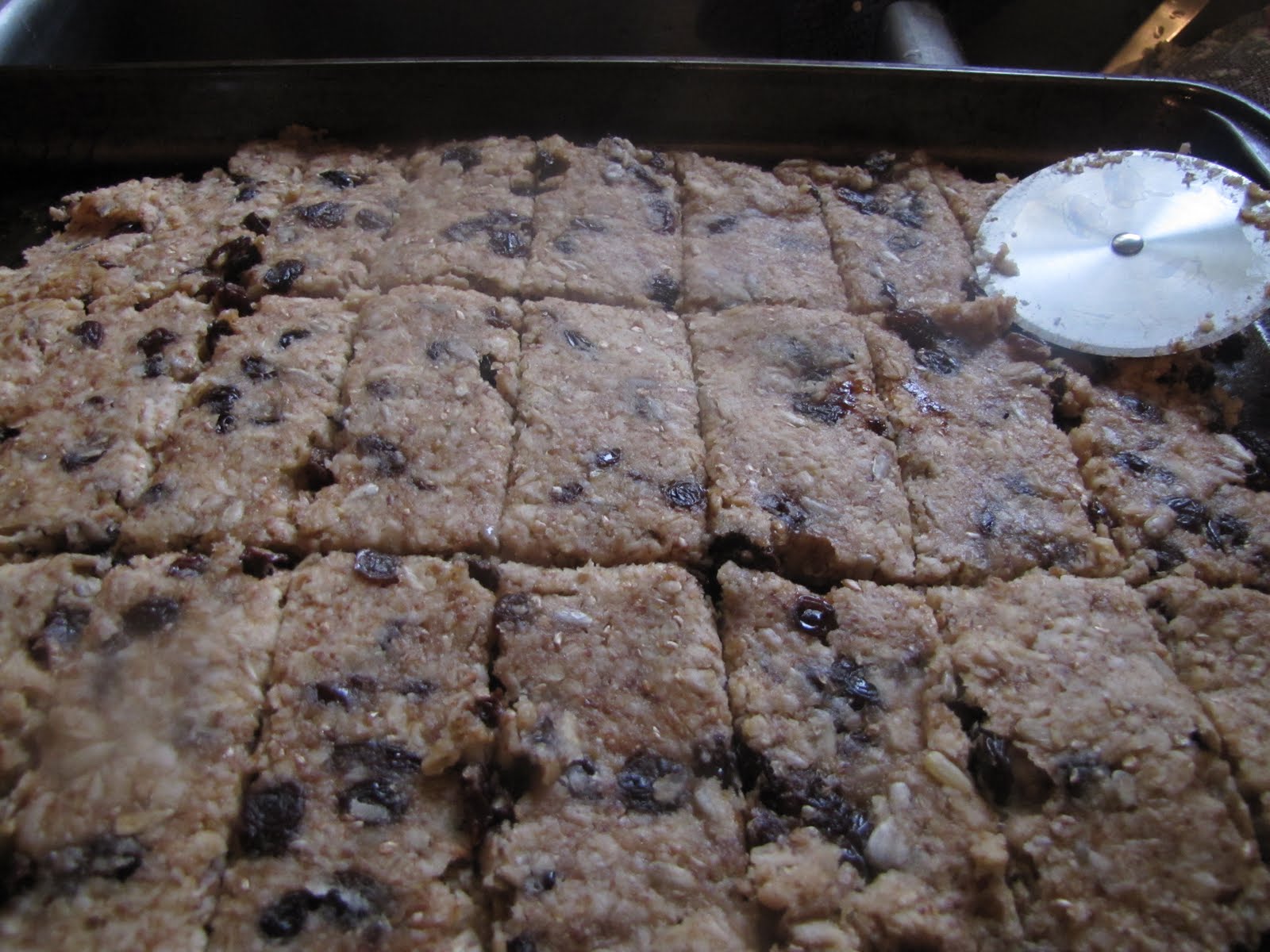
Step 8:  Peel off your top layer of paper and cut your bars with a pizza cutter.


Step 9:  Transfer your bars to the dehydrator and turn it on until they dry.  It took my really thick bars about 6 hours to completely dry today.


Step 10:  Enjoy!


Here is a picture of one of the thin ones for the children and the big, thick, Mommy-sized bars :)


It's as easy as that - a fresh, healthy snack for your family without all of the nasty additives, preservatives and sugars. 

-Jess

Thursday, March 18, 2010

Q&A: High Fructose Corn Syrup

I was wondering if you have ever tried doing a high fructose corn syrup (HFCS) free diet. I recently saw a youtube video called "Sugar: The Bitter Truth". It's really long and kind of boring, but it scared me away from HFCS. I've been thinking about trying to do a HFCS free diet, but I've noticed it's in just about everything we have. Have you tried this? Have any tips?

My Views on Sugar

I limit the amount of sugar that I consume for many reasons.  Sugar consumption leads to obesity, heart attacks, artery disease, tooth decay, diabetes, metabolic issues, concentration issues, fertility problems, and upsets the balance of the endocrine and nervous systems. 

Our ancestors did not consume sugar in the same ways we do and our bodies were not designed to consume it in large quantities.  In the past, natural sweeteners were used sparingly to sweeten foods and desserts were viewed as a treat reserved only for special occasions.  But now, the average American consumes more than 22 teaspoons of sugar per DAY (mainly from beverages like soft drinks) and many children and teenagers consume almost double that amount.

If you shop in the grocery store and consume mostly processed foods, you can pretty much guarantee that everything you eat has some type of sweetener in it.  Our taste buds have grown so accustomed to tasting it, that we hardly recognize exactly how sweet our foods are.

And here is the problem with the way we consume sugar in our society - most of our sugary foods (like soft drinks and candy) do not contain fat.  Fat slows the sugar from entering our blood stream in a rush and stimulating insulin and hormone production.  Our "high carb/low fat" diets are literally killing us.  In fact, we should be doing the opposite - consuming higher levels of healthy fats and less carbohydrates.

As a rule for myself, I avoid refined sugars, artificial sweeteners, and even some "natural" sweeteners.  The only sugars I consume are fruits, raw honey, and unrefined maple syrup.  Occasionally I will crave a soft drink or a cookie with sugar, but I reserve those foods for special occasions and do not keep them in the house for myself.

This year for Lent I gave up sugar (except fruit) - honey and maple syrup included - and have not intentionally consumed it for over a month now.  For the first four days my body crashed.  I was irritable, tired, and hungry all of the time.  We forget that sugar is actually a drug (an addictive one) that affects not only your blood sugar, but also your brain chemistry.

But once I made it past those first four days, I noticed that my energy levels started to increase and my mind felt clearer than normal.  After a few weeks more, my appetite started to decrease and I now don't feel the need to snack as much.  My body no longer craves those foods throughout the day.

So, you're probably wondering - what can a person eat if they avoid sugar completely?  Here was my food intake yesterday:

Breakfast - 2 slices of raisin toast with butter and 2 scrambled free-range eggs mixed with chopped spinach.

Snack - some almonds and a few apple slices

Lunch - canned tuna mixed with olive oil and salt/pepper, and a few slices of cheese on homemade bread

Snack - a banana and some pumpkin seeds

Dinner - chuck roast (with the broth used as a condiment for dipping), okra breaded in spelt flour and fried in olive oil, and a bowl of grapes

Snack - 3 pieces of cheese and a slice of homemade toast with butter
My beverages most days consist of unsweetened hot and iced teas, water, and fruit smoothies.

The hardest part about going sugar-free is not having condiments with your foods.  Most store-bought condiments contain HFCS - ketchup, barbecue sauce, taco sauce, salad dressings, mayo, salsa, etc.  In order to have condiments with your food if you are going to go sugar-free, you have to make your own.  If you are just trying to eliminate HFCS from your diet, most organic brands of condiments contain organic sugar or other sweeteners.  They are a little more expensive, but worth it in my opinion - just use a little less to make up for the cost.

Other ways to avoid HFCS and sugars:
  • Make your own jams and jellies, or buy the brands labeled "no sugar added".  Fruit is sweet enough; it doesn't need more sugar to taste good on bread. 
  • Make sure your fruit juice has no added sugar.  Many juices can contain as much, if not more sugar than a can of soda.
  • Make your own salad dressings.  My favorite recipe is a mixture of virgin olive oil, lemon juice, a squeeze of raw honey, garlic, salt, pepper, and any herbs I am in the mood for (dill, sage, rosemary, etc.)
  • Buy plain peanut butter.  The average brand of peanut butter contains more than one type of sugar - HFCS, molasses, honey AND sugar.  Usually when you eat peanut butter, you are spreading it on bread with jelly, which is sweet enough.  You don't need added sugar in your peanut butter.
  • Bake your own bread.  You can even substitute raw honey for sugar in most bread recipes to avoid refined sugars.  Or even better, make some homemade sourdough without any sweeteners at all.
  • Always read your labels and buy unsweetened/plain when available.  You can always add a little honey or sugar to your food if it needs it, but you rarely need the amount that is in the sweetened versions of foods (for example: applesauce and yogurt).
  • Don't buy canned fruit.  Aside from the fact that the lining of the cans is toxic, most of the fruits are soaked in syrup.
  • Cook your food at home.  Nearly everything you eat at a restaurant contains HFCS and sugar.
  • Avoid buying processed foods that say "sugar free".  The sugar in these foods has usually been replaced with artificial sweeteners, which are just as bad for you as HFCS.
  • Watch your processed meats.  Most of them contain sweeteners.
What is the difference between a natural sweetener and a refined sweetener?  Which ones are the best for me?

The following are natural sweeteners. This means they are the least processed and they contain more vitamins and minerals. Use these if you have a sweet tooth!
  • Raw Honey
  • Unrefined Maple Syrup
  • Agave Nectar
  • Date Sugar
  • Sorghum Syrup
  • Barley Malt Syrup
  • Fruit
The following are natural sweeteners that should be avoided for various reasons.
  • Concentrated Fruit Juices - They are composed mainly of fructose in levels so concentrated that your body is unable to regulate blood sugar properly.
  • Raw, Natural, Turbinado, Sucanat, and Florida Crystals - They upset your body chemistry and are refined, which removes most of the nutrients.
  • Brown Rice Syrup - The rice is cooked with enzymes, which are many times genetically modified.
  • Stevia - It is a calorie-free, herbal substitute that does not affect blood sugar. Although it has many medicinal uses, including the treatment of heartburn, its safety is still questionable.
  • Molasses - A byproduct of the processing of sugar cane with a strong taste and moderate sweetness. If it comes from sugar cane grown in the right type of soil, it can contain especially high levels of iron, calcium, zinc, copper and chromium.
The following are refined sweeteners that should be avoided.
  • White Sugar (sucrose) - has little, if any, nutritional value
  • Brown Sugar
  • Refined maple syrup - formaldehyde is used in the production.
  • Corn syrup - is usually genetically modified.
  • Fructose - causes deleterious effects, especially in small children
  • Glucose
  • Dextrin - made by boiling corn starch with acid
  • Dextrose
  • Processed honey
  • Maltodextrin
The following are artificial sweeteners, which have been linked to headaches, gastro-intestinal problems, panic attacks, depression, nervous system disorders (specifically fibromyalgia and multiple sclerosis), male infertility, cell damage, and cancer (specifically bladder and reproductive organs).  NEVER EAT THESE!
  • Aspartame - linked to cancer of the reproductive organs.
  • Saccharin - linked to bladder cancer
  • Mannitol
  • Sorbitol - labeled to warn of nausea, diarrhea, and vomiting.
  • Xylitol
  • Splenda (sucralose) - a chlorocarbon (contains chlorine) linked to organ, genetic and reproductive damage. Lab rats show a 40% shrinkage in thymus gland (foundation of immune system) when given Splenda.
Here's the bottom line!

Avoiding sugar is easy to do if you are willing to put in a little hard work first.  Your body is going to have to detox and it is going to be uncomfortable for a few days or even weeks.  But, once you get past the initial withdrawal, you will start to feel so good that you'll realize a soda isn't worth it.  Your taste buds will also change and most of the foods you once thought tasted good will become too sweet for you.

Make your own food and read your labels.  And as always - everything in moderation.  You're not going to die if you eat a cookie or drink a soda every now and then, but when you eat them day after day your body and brain become addicted and the sugar begins to get every system in your body out of whack.  Stick to natural sweeteners and use them in moderation.

-Jess

Sources

"Exactly What Is Splenda? .: Ask Dr. Hull." Dr. Janet Starr Hull, PhD, CN - Website. Web. 11 Sept. 2009. .

"Substitute Natural Sweeteners for Artificial Sweeteners." Body Cleansing / Detox Plan and Natural Cures. Web. 11 Sept. 2009. .

"Top 10 Dangers of Artificial Sweeteners." Nutrition Supplements News. Web. 11 Sept. 2009. .