On October 1 my six-year-old son and I began our own version of the Specific Carbohydrate Diet/GAPS Diet/Paleo eating plan. We made the decision to do it for a few reasons. First, I have Crohn's Disease and over the course of the last five years have been able to wean myself down to the minimum dosage of my maintenance medication, but have never felt completely comfortable with quitting it cold-turkey because I've been either pregnant or nursing at the time. I'm currently nursing a ten-month-old, but feel like it's a good time to try to go off the medication before another potential pregnancy.
The reason we decided to have my son do it is because he is allergic to peanuts and dairy. He turned six years old last August and while he has outgrown many other food allergies over the last few years (eggs, soy, pineapple, and tomato), these two allergies have actually gotten worse according to test results. My son nursed as a baby and never had a reaction to what I ate and was in my milk. He even received pumped milk up to the age of nearly three without reactions to what was in the milk, but when I tried to give him some of my pumped milk for an added probiotic boost last year he reacted to it. Even after avoiding dairy and peanuts for several weeks and trying again, he still had a reaction. Because of this and the fact that very few children outgrow their allergies if they haven't already by Kindergarten age, we knew that it was going to take something drastic, combined with a lot of prayer, to heal his body. Others have had luck with food allergies on the GAPS diet, so we thought we would give it a shot. At this point we have nothing to lose.
I'd had Breaking the Vicious Cycle, the book about the SCD diet, sitting on my bookshelf for years and had been ignoring it despite having people in my life tell me I should try it. It wasn't until a friend told me about her experience with her autistic son and the GAPS diet and then hearing about another woman at a Weston A. Price meeting who had "cured" her Crohn's Disease with the same diet, that I decided I needed to look into it.
The SCD, GAPS and Paleo diets are all very similar. You avoid all grains (not just gluten), including things like rice, oats, quinoa, potatoes, and other foods that people with gluten intolerances can eat. No sugar, preservatives, or other food additives are allowed. Basically, you can eat pastured meats, pastured eggs, raw dairy, organic fruits/vegetables, properly soaked nuts (and nut flours and butters), lentils, split peas, navy beans, honey, oils (we only eat coconut and olive), and a few other things. All of the diets vary a little in what they will and won't allow, but the point is the same - no grains and sugar, a therapeutic probiotic regimen, and clean eating so that your "leaky gut" can heal.
Preparing for the Diet
We spent the month of September preparing for the diet. Since we are already dealing with food allergies, intolerances, and special diets in our home, going on such an intense diet wasn't nearly as scary as it would be for most people. We haven't been able to eat at restaurants or eat processed foods for years now, so we didn't have to worry about adjusting our lifestyles to eat this way. We also already had sources for many of the foods on the plan, like pastured eggs/meat and raw dairy. We have basically been eating this way for years without completely cutting out sugar and grains, so that was going to be the hard part for us. For others who have to completely change the way they look at food, this process would seem much more overwhelming and difficult.
I also think that this diet would be very difficult for the average child. Most of the foods that children enjoy (and that are convenient for parents to feed them), such as breaded chicken nuggets, breads, cookies, crackers, french fries, candy, macaroni and cheese, etc. are not allowed on the diet. We didn't have to deal with a child that was being forced to give up the foods he liked, because our son has never been able to enjoy many of those foods due to his food allergies. He is used to not being allowed to eat what other people around him are enjoying.
There were some foods that were hard for my son to give up, mainly some of his favorite sugary treats. For me it was sourdough bread, bacon, and homemade pancakes with maple syrup. Eventually, we both weaned off of our grain and sugar addictions and I learned how to cook "legal" options that would replace them using nut flours and honey. We used the month of September to wean ourselves off of those foods and for me to refine my skills in cooking with our new staples.
Starting the Diet
On October 1, 2013 we officially began. We followed the GAPS protocol and for the first week we ate nothing but homemade bone broth to allow our digestive systems to heal. On top of this, my son started a new therapeutic dose of probiotics (I was already on a therapeutic dose). He went from taking 12 strains at 3 billion to 12 strains at 10 billion and I continued at 12 strains at 20 billion.
The first week was terrible. We both experienced very severe-die off reactions as our bodies purged the bad bacteria. By the second night we were both waking through the night and vomiting. This lasted about five days before we finally felt better.
I experienced a slight dip in my milk supply during the first few days, so I began eating homemade raw milk yogurt by day three. Since my son cannot have dairy, he was simply on the bone broths. Our next food we introduced was cooked vegetables in the broth and homemade sauerkraut, followed by egg yolks and cooked meats. By week three we were eating nut flours made from nuts that I had properly soaked and dehydrated, along with cooked fruits. The very last things we added were raw fruit and soaked lentils, split peas, and navy beans after the end of the first month.
Six weeks into the diet we were both feeling great and decided to up our probiotic dosage again. My son began taking 12 strains at 13 billion and I upped it to 12 strains at 23 billion. We did not experience a severe die-off the second time.
At the two month mark I hadn't taken my maintenance medication for my Crohn's Disease and was experiencing zero symptoms. In fact, my body was having the opposite reaction and I became very constipated and was only having a bowel movement once a week. Three months out and I'm still having problems with this issue. For years with my Crohn's Disease I have had to avoid trigger foods that would cause symptoms to flare, such as raw peppers, lentils, onions, or broccoli to name a few. I have learned that cutting out the fiber from all grains and then still avoiding those trigger foods makes digestion very difficult. I've had to change the way I eat and allow myself to consume small amounts of the trigger foods in order to stay "regular". It has been wonderful to enjoy a bowl of split pea soup or some raw peppers after avoiding them for nearly a decade.
The Results at Three Months
After three months I feel amazing. My nursing baby still wakes three times a night to eat and with previous babies I was feeling very run-down and could feel my immune system crashing and the Crohn's symptoms beginning to flare by this point. I feel like the diet has given me a tremendous amount of energy and I feel so healthy that the sleep-deprivation isn't as much of an issue. I imagine that I would feel like a million dollars if I were also getting solid sleep on top of this diet.
The effects of the diet on my son have also been amazing. After that first week of die-off he began having formed stools for the very first time in his life. His digestion is now very regular and solid. Another amazing result has been his weight gain. You would think that by cutting out nearly half of the foods he can eat, he would lose a lot of weight (which has been the case for me simply because I'm eating and craving less - I've lost all of my baby weight and then some, a total of 20 pounds in three months), however, he has had the opposite reaction. My son has always been extremely tiny, under the tenth percentile on the growth chart for weight most of the time. At age six he weighed 38 pounds, which was the same weight he had been for over a year. He lost two pounds during the first six weeks of the diet, but right before Christmas he was weighed again and had gained that two back plus another three pounds. Cutting out half of his diet and eating much more nutrient-dense food has resulted in a five pound weight gain after over a year and a half of no growth. This proves to me that his body is now absorbing more of the food he is eating and his digestion is getting more efficient. Since the goal of the diet is to heal the gaps in the intestinal wall, I have faith that this is a sign that something is happening there!
I plan to write more here about our journey, which will last at least two years, and also share some of our favorite recipes and tips for surviving this diet. If you or a family member are suffering from an autoimmune disease, food allergy/intolerance, or other ailment in which traditional medicine is failing you or giving you few options for full healing, this is something that may be an option for you. I won't lie, this diet is extreme and you have to follow it fanatically in order to see any benefit, but there are countless testimonies from people who have done it and have had great outcomes.
-Jessica
Showing posts with label grains. Show all posts
Showing posts with label grains. Show all posts
Saturday, January 4, 2014


Thursday, June 24, 2010
If you want to get sick and gain weight...
...follow the 2010 USDA Food Pyramid Guidelines.
Here is a great article about the proposed changes, written by Sally Fallon Morell, President of the Weston A. Price Foundation.
Some highlights of the article (emphasis mine):
I went to mypyramid.gov and took their MyPyramid Plan (2005 Guidelines) and for a woman my age and size, and with my activity level, they are recommending the following food plan:
Yikes! If I ate like that I can't even imagine how horrible I would feel. My day looked like this today:
The government would like people to think that eating a diet like my family's will make us obese, with heart disease.
For Gabe and David, young boys with brains and bodies still developing, they recommend the following diet:
With a healthcare crisis in our country, I cannot believe that our government could be so blind to common sense nutrition.
Here is how we can stay healthy - Eat whole foods. Eat food that God put on this earth for us to consume, not things created by man in a laboratory somewhere. Cook our food at home. Eat organic. Avoid processed carbohydrates and sugar.
It's really pretty simple.
-Jessica
Here is a great article about the proposed changes, written by Sally Fallon Morell, President of the Weston A. Price Foundation.
Some highlights of the article (emphasis mine):
“Basic biochemistry shows that the human body has a very high requirement for saturated fats in all cell membranes; if we do not eat saturated fats, the body will simply make them from carbohydrates, but excess carbohydrate increases blood levels of triglyceride and small, dense LDL, and compromises blood vessel function,” says Fallon Morell. “Moreover, high-carbohydrate diets do not satisfy the appetite as well as diets rich in traditional fats, leading to higher caloric intakes and often to bingeing and splurging on empty foods, resulting in rapid weight gain and chronic disease.”
The proposed guidelines will perpetuate existing nutrient deficiencies present in all American population groups, including deficiencies in vitamins A and D found in animal fats, vitamins B12 and B6 found in animal foods, as well as minerals like calcium and phosphorus, which require vitamins A and D for assimilation. Moreover, low intakes of vitamin K2, are associated with increased risk of heart disease and cancer. The main sources of vitamin K2 available to Americans are egg yolks and full-fat cheese. Incredibly, the Guidelines single out cheese as an unhealthy food!
The Guidelines lump trans fats together with saturated fats—calling them Solid Fats—thereby hiding the difference between unhealthy industrial trans fats and healthy traditional saturated fats. Trans fats contribute to inflammation, depress the immune system, interfere with hormone production, and set up pathological conditions leading to cancer and heart disease, whereas saturated fats fight inflammation, support the immune system, support hormone production and protect against cancer and heart disease.Her version of the food pyramid looks like this:
Every day, eat high quality, whole foods to provide an abundance of nutrients, chosen from each of the following four groups:Here is another interesting article about the new guidelines, written by Robert K. Su, MD, which also supports the idea that a diet high in carbohydrates is a recipe for disease and obesity, and that a diet rich in whole foods and animal fat is much healthier.
1.Animal foods: meat and organ meats, poultry, and eggs from pastured animals; fish and shellfish; whole raw cheese, milk and other dairy products from pastured animals; and broth made from animal bones.
2.Grains, legumes and nuts: whole-grain baked goods, breakfast porridges, whole grain rice; beans and lentils; peanuts, cashews and nuts, properly prepared to improve digestibility.
3.Fruits and Vegetables: preferably fresh or frozen, preferably locally grown, either raw, cooked or in soups and stews, and also as lacto-fermented condiments.
4.Fats and Oils: unrefined saturated and monounsaturated fats including butter, lard, tallow and other animal fats; palm oil and coconut oil; olive oil; cod liver oil for vitamins A and D.
I went to mypyramid.gov and took their MyPyramid Plan (2005 Guidelines) and for a woman my age and size, and with my activity level, they are recommending the following food plan:
- 7 ounces of grains
- 3 cups vegetables
- 2 cups fruit
- 3 cups milk
- 6 ounces meat and beans
- 3 cups dark green veggies (are they joking??)
- 2 cups orange veggies
- 3 cups dry beans and peas
- 6 cups starchy veggies
- 7 cups other veggies
Yikes! If I ate like that I can't even imagine how horrible I would feel. My day looked like this today:
- Breakfast: 2 pastured eggs fried in butter, 1/2 cup soaked oatmeal with raw milk and honey, and some blueberries
- Snack: apple
- Lunch: pastured round steak (fried in olive oil and then baked in tomato/basil sauce), quinoa noodles (in the same tomato sauce) and salad with olive oil dressing
- Snack: homemade whole wheat pretzels (made with coconut oil)
- Dinner: pastured beef liver (fried in nitrate-free bacon grease - I was a bad girl), peas, rhubarb, and watermelon
- Drinks throughout the day: tea, raw milk and water
The government would like people to think that eating a diet like my family's will make us obese, with heart disease.
For Gabe and David, young boys with brains and bodies still developing, they recommend the following diet:
- 3 ounces grains
- 1 cup vegetables
- 1 cup fruit
- 2 cups milk
- 2 ounces meat and beans
- only 3 teaspoons of oil per day
With a healthcare crisis in our country, I cannot believe that our government could be so blind to common sense nutrition.
Here is how we can stay healthy - Eat whole foods. Eat food that God put on this earth for us to consume, not things created by man in a laboratory somewhere. Cook our food at home. Eat organic. Avoid processed carbohydrates and sugar.
It's really pretty simple.
-Jessica
Friday, April 30, 2010
Homemade Soaked Granola Bars
Granola bars are considered a healthy snack by many people - they usually contain oats, nuts, dried fruits and other things that are good for you. But most of the processed bars also contain a lot of things that are very bad for you.
Let's look at Nature Valley's 100% Natural Chewy Trail Mix - Fruit & Nut bars.
What about something that is considered a little more healthy - Kashi's TLC Chewy Granola Bars Honey Almond Flax?
Only FIVE sugars in this one.
But the sugars aren't the only unhealthy thing about these "healthy" snacks. They both use genetically modified ingredients, canola oil (at least Kashi's is expeller pressed), and those mysterious "natural flavors" that could include just about anything.
Your best bet is to make your own granola bars. I found a wonderful recipe here that I decided to modify using soaked grains and nuts. Remember that it is always important to soak your grains, nuts, legumes and beans before consuming them!
Here is how I made my chewy granola bars. To make my recipe you will need a dehydrator. I will also warn you that I didn't measure anything - you can't really mess this up, so just use as much as you want of each ingredient.
Step 1: Soak some organic oats, raw almonds, and raw sunflower seeds for 12-24 hours. The longer you soak, the better.
Step 2: Drain and rinse your ingredients and then dehydrate them for a while. I did it until the oats were half dry.

Step 3: Pulse your almonds in the food processor.

Step 4: Toss your oats, almonds, and seeds into a large mixing bowl. Add your dried fruit - I used raisins and chopped dried figs. Add your sweetener - I used raw, local honey.

Add your fat - I used coconut oil so that my dairy-allergic son can eat them, but butter would also taste great. Add anything else you want - I used cinnamon and flax meal.

Step 5: Mix. Skip the spoon and just use your hands - it's much easier.

Step 6: Put some wax paper on a flat surface and plop your ingredients on top.

Step 7: Put another piece of wax paper over your ingredients and roll them until they are the desired thickness. I like mine thicker. Just remember that the thicker they are, the longer they will take to dehydrate.
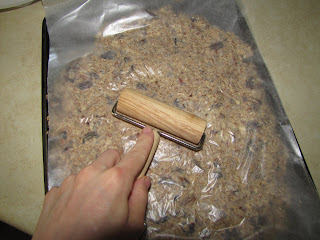
Step 8: Peel off your top layer of paper and cut your bars with a pizza cutter.

Step 9: Transfer your bars to the dehydrator and turn it on until they dry. It took my really thick bars about 6 hours to completely dry today.

Step 10: Enjoy!
Here is a picture of one of the thin ones for the children and the big, thick, Mommy-sized bars :)


It's as easy as that - a fresh, healthy snack for your family without all of the nasty additives, preservatives and sugars.
-Jess
Let's look at Nature Valley's 100% Natural Chewy Trail Mix - Fruit & Nut bars.
Ingredients: whole grain oats, high maltose corn syrup, rice flour, raisins, almonds, honey, sugar, roasted peanuts, fructose, sunflower seeds, canola oil, cranberries, maltodextrin, soy lecithin, salt, malt extract, baking soda, natural flavor, and mixed tocopherols.That's EIGHT different sugars in one little granola bar. Yikes!
What about something that is considered a little more healthy - Kashi's TLC Chewy Granola Bars Honey Almond Flax?
Ingredients: rolled grain blend (hard red wheat, oats, rye, triticale, barley), roasted salted whole almonds, brown rice syrup, soy protein isolate, soy grits, evaporated cane juice crystals, chicory root fiber, whole flax seeds, evaporated cane juice syrup, rice starch, corn flour, honey, expeller pressed canola oil, vegetable glycerin, oat fiber, natural flavors, evaporated salt, Kashi seven whole grains sesame flour (whole: oats, hard red wheat, rye, brown rice, triticale, barley, buckwheat, sesame seeds), molasses, soy lecithin, peanut flour, whey protein isolate.
Only FIVE sugars in this one.
But the sugars aren't the only unhealthy thing about these "healthy" snacks. They both use genetically modified ingredients, canola oil (at least Kashi's is expeller pressed), and those mysterious "natural flavors" that could include just about anything.
Your best bet is to make your own granola bars. I found a wonderful recipe here that I decided to modify using soaked grains and nuts. Remember that it is always important to soak your grains, nuts, legumes and beans before consuming them!
Here is how I made my chewy granola bars. To make my recipe you will need a dehydrator. I will also warn you that I didn't measure anything - you can't really mess this up, so just use as much as you want of each ingredient.
Step 1: Soak some organic oats, raw almonds, and raw sunflower seeds for 12-24 hours. The longer you soak, the better.
Step 2: Drain and rinse your ingredients and then dehydrate them for a while. I did it until the oats were half dry.

Step 3: Pulse your almonds in the food processor.

Step 4: Toss your oats, almonds, and seeds into a large mixing bowl. Add your dried fruit - I used raisins and chopped dried figs. Add your sweetener - I used raw, local honey.

Add your fat - I used coconut oil so that my dairy-allergic son can eat them, but butter would also taste great. Add anything else you want - I used cinnamon and flax meal.

Step 5: Mix. Skip the spoon and just use your hands - it's much easier.

Step 6: Put some wax paper on a flat surface and plop your ingredients on top.

Step 7: Put another piece of wax paper over your ingredients and roll them until they are the desired thickness. I like mine thicker. Just remember that the thicker they are, the longer they will take to dehydrate.

Step 8: Peel off your top layer of paper and cut your bars with a pizza cutter.
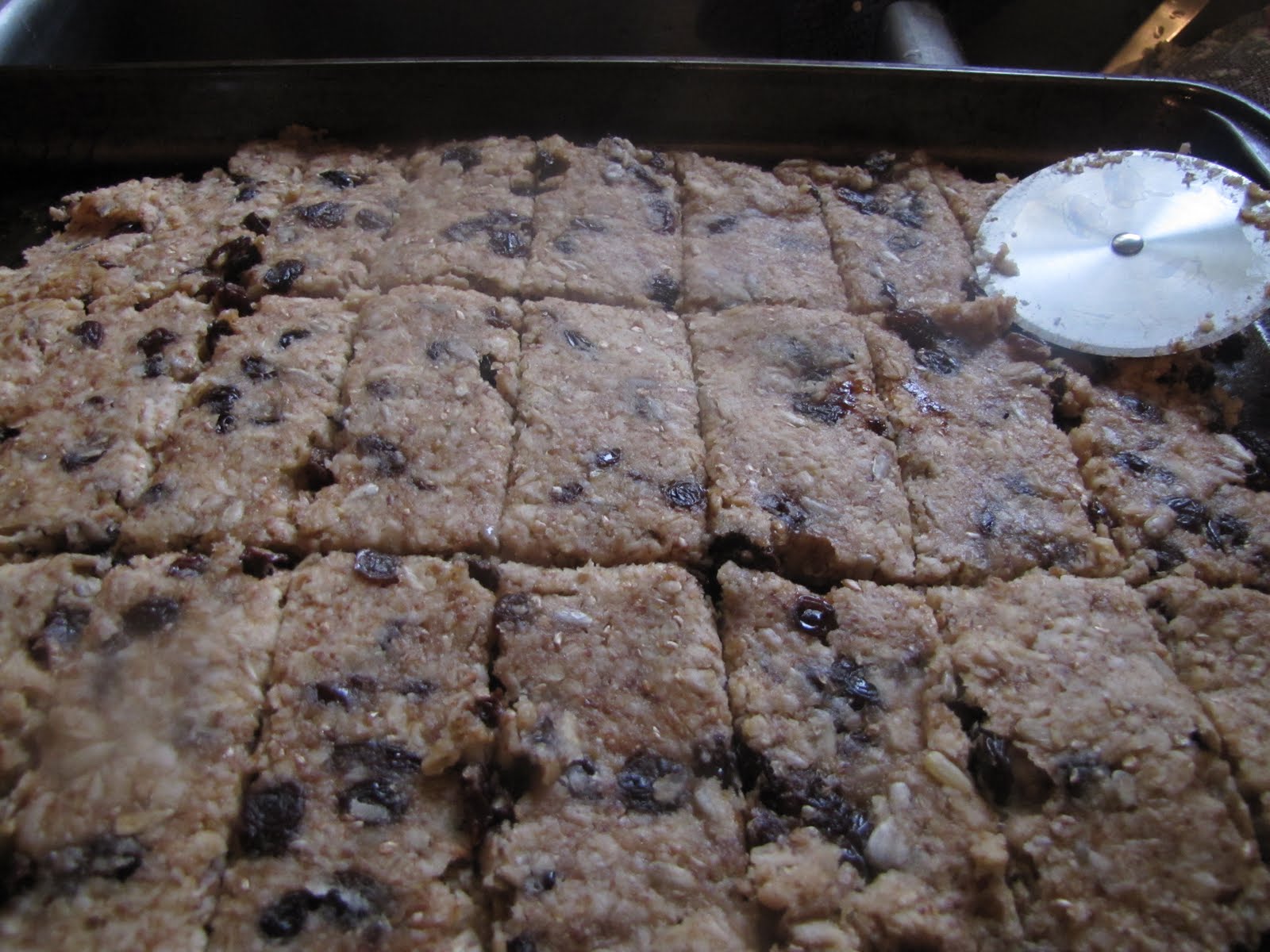
Step 9: Transfer your bars to the dehydrator and turn it on until they dry. It took my really thick bars about 6 hours to completely dry today.

Step 10: Enjoy!
Here is a picture of one of the thin ones for the children and the big, thick, Mommy-sized bars :)


It's as easy as that - a fresh, healthy snack for your family without all of the nasty additives, preservatives and sugars.
-Jess
Friday, March 19, 2010
How To Make Homemade Sourdough Bread

What are the advantages of sourdough bread?
- Sourdough bread is easier to digest because of the lactic acid created in the fermentation process.
- The soaking that is a part of making sourdough bread decreases phytate content, which allows for better nutrient absorption.
- It causes a lower spike in blood sugar than any other type of bread.
- It does not spoil as easily as bread made from brewers yeast because its acetic acid retards mold growth.
- It tastes DELICIOUS!
Your first step is to make a sourdough starter.
My recipe came from Nourishing Traditions. It yields 3 quarts of starter.
I took 2 cups of rye flour and 2 cups of filtered water and mixed them together in a large bowl. Then, I covered the soupy mixture with a double layer of cheesecloth and secured it with a rubber band.
You can see my bowl in this picture (note that my kitchen counters have become a "laboratory" for soaking and sprouting).

For the next 7 days, I transferred my soupy mixture to a different bowl each day and added one cup of rye flour and another cup of filtered water. I would then mix it and put the cheesecloth back on top.
During the week, the cheesecloth allowed good bacteria (lactobacilli) and airborne fungus (wild yeast) to enter my soupy mix, causing it to froth and bubble. After about 3 days it began to smell badly, but by the end of the week it smelled like wine.
This is what it looked like after 7 days.

At this point, it was ready to be used for making bread.
A sourdough starter is a living thing that needs to be cared for just like any other living thing. If you aren't going to use it right away, you can store it in the fridge or freezer. Just make sure that you "feed" the starter with one cup of flour/water at least once a week and allow oxygen to get to it.
Starters make a wonderful gift for friends and family - just give them a few cups and tell them to feed it every day until they build up their supply.
The taste of your starter and it's ability to leaven bread will get better with age, so be patient and don't give up if your first batch of bread doesn't taste perfect!
Note: many websites will tell you that you shouldn't use metal bowls or utensils for your starter. I used a stainless steel bowl for mine and did not have a problem. Everything I've read says that anything other than stainless steel is not advised, but essentially the "no metal rule" is a myth.
Now you are ready to make your bread.
Once again, I used the Nourishing Traditions recipe.
I used 2 quarts of my starter (needs to be at room temperature) and added 2 1/2 tablespoons of sea salt and 1 cup cold filtered water.

Mix it until the salt dissolves. Then, start mixing your flour (you will add 13 cups in all). I used whole wheat.

Halfway through you will need to add another 1/2 cup cold filtered water and start mixing with your hands.

Then, knead the dough for about 15 minutes. This will be a workout, BELIEVE me! My arms were sore afterwards.

Section your dough into your loaf sizes. I made five medium-sized loafs.

Grease your loaf pans. I used coconut oil because of Gabe's dairy allergy.

Form your loaves and put them in their pans.

Make sure to add some slices to the tops of your loaves.

Then cover your loaves and let them rise.

Leavening time will depend on the age and quality of your starter - the older the starter, the shorter the time. Some starters may take as little as a few hours, but other may take a day or longer. Remember that your dough will not spoil, because the fermentation process protects it.
I let mine rise for 19 hours and this is what they looked like afterwards.

Bake at 350 for an hour and your bread is done!
I sliced several of my loaves and froze them. This will make it easy to grab a few pieces as needed for toast.

Enjoy!
-Jess
Friday, January 22, 2010
Treat Your Skin With Oatmeal
My sons have very sensitive skin. We are constantly battling hives, eczema, diaper rashes and other irritations. Lately I have found oatmeal baths to be one of the best remedies - it is natural, cheap, and easy to use.
Putting oatmeal in your bath water is one of those folk remedies known to heal things like bug bites/stings, sunburns, psoriasis, rashes, chicken pox, and many other common skin problems.
Here is why oatmeal helps soothe skin:
- The saponins (the coating of the oat) act as a natural cleanser by absorbing dirt and oil, normalizing your skin's pH balance. In plants, saponins protect against fungi and microbes (the avenacins in the oats are also antifungal). Although you don't want to consume the saponins in your oatmeal (this is why you soak them), they are believed to be beneficial helping to heal skin irritation.
- The phenols and flavanoids in the oats provide UV protection and fight free radicals. These are ingredients you often see added to anti-aging creams.
- Oatmeal also contains Vitamin E, which helps fight inflammation.
How to prepare an oatmeal bath
You are supposed to grind your oats into a powder so that when water is added, they are evenly dispersed and do not just simply sink to the bottom of the tub. This ground oatmeal is called colloidal oatmeal.
I use a method that saves me a step. Simply take either the leg on an old pair of hose or one of your trouser socks and fill it with whole oats. You can use this as an oatmeal "teabag" in the tub.
Colloidal simply means "gelatinous". By taking my bag of oatmeal and squeezing it, I can feel a "gluelike" residue filling the tub.
Once I have steeped the bag in the water long enough that the water looks cloudy, I then take the actual bag and rub it over the rash, making sure to squeeze the "juice" from the oats directly over it.
Your skin will feel slimy to the touch when you are done, but don't rinse off before you leave the tub. The residue will help protect your skin.
After you are done with the bag of oatmeal, just squeeze out the oats, turn it inside out and rinse. You can reuse the hosiery over and over again.
What about the oatmeal bath products sold in stores?
Aveeno products are the most common oatmeal-based products and actually score well on the Skin Deep Cosmetic Safety Database. The ingredients in the Soothing Baby Bath Treatment are: mineral oil, laureth-4, calcium silicate, and colloidal oatmeal. The only questionable ingredient is the laureth-4, which is actually a skin and eye irritant (it seems silly to treat your skin with something that will irritate it).
Why purchase a product with extra ingredients that may not be helping you, when you can use the real thing for much cheaper?
-Jessica
Tuesday, October 20, 2009
Food Combinations For Optimal Health
Several years ago Adam and I noticed that the order in which we were eating our foods was having an effect on our digestion. At the time I was reading The Maker's Diet by Jordan Rubin, which talked a little about food combining diets. We looked into it briefly and made a few changes to our diets - mainly eating our salads and fruits first so that they didn't sit and rot in our stomachs after we were done eating. Adam noticed a change in his digestion immediately.
On the way home from work a few weeks ago, he heard a radio program by Dr. Ann Wigmore about food combinations and it reignited our interest in the topic. Many of the things we have learned during our research over the past few weeks has been very interesting.
Fun food-combining facts:
Eat Vitamin C with Green Tea because it increases the absorption of the antioxidants in the tea. For example - squeeze lemon into your tea.
Eat Vitamin-rich foods with Fats because many essential vitamins (especially A,D and E) are absorbed best by the body when eaten with fats. For example - cook your vitamin-rich veggies in an oil.
Eat Garlic with Fish because studies show the garlic helps lower the LDL-cholesterol in fish oil.
Eat Turmeric with Black Pepper because the piperine in the pepper increases the anti-cancer, anti-inflammatory, and tumor-fighting effects of the turmeric.
Eat Rosemary with Grilled Meat because the herbs antioxidants soak up the carcinogens in the meat. Eating cruciferous vegetables with grilled meat is also recommended. Read more about that here.
Eat Leafy Greens with Citrus because Vitamin C helps your body absorb plant-based iron. For example - squeeze lemon on your spinach.
Eat Oatmeal with Vitamin C because the combination of the phenols in both foods stabilizes LDL cholesterol. For example - squeeze an orange into your oatmeal.
Other Food Combination Rules:
These are based on Dr. Ann Wigmore's program.
1 - Eating one food per sitting is always best.
2 - Melons should always be eaten alone.
3 - There are three kinds of fruits - acid, subacid and sweet. Never eat acidic (orange, grapefruit, pomegranate, strawberry, pineapple, tangerine, lemon, lime, and kiwi) and sweet (banana, dates, raisins, papaya, fresh fig, grapes, persimmon and other dried fruits) together.
4 - Don't mix fruits and veggies, except for tomatoes.
5 - Don't mix starches and proteins, because starches create alkali in the stomach, while proteins create acid - they neutralize one another and make digestion difficult.
6 - Don't drink while eating because it dilutes your stomach acid and enzymes, making it harder to digest food.
7 - Eat raw foods before cooked.
8 - Only eat one type of protein per meal.
9 - Don't eat milk with meat.
10 - Don't drink wine with ale or beer.
Some of these things seem like common sense, but others go against everything our society teaches about healthy eating. We have always been told that you should eat a well-balanced meal, complete with protein, carbs, fruits, veggies and a large glass of water to keep you from overeating. This research by Dr. Wigmore shows that doing so causes serious digestive problems, which may be the reason that the average American walks around with nearly 5 pounds of undigested, rotting meat in their system.
We hear a lot about how eating small meals, or grazing, throughout the day is a great way to keep your metabolism burning, but it may also be a good way to follow these food combination rules. Eating one item at each sitting, several times throughout the day, may be the best way to keep your digestive system healthy.
I realize that there are a lot of different rules out there and it is really hard to keep them all in mind when you are planning a meal. I think that every little bit helps and if you can remember to do a few of them at a time it is better than not doing any of them at all. Eventually the rules will become easier to follow as you slowly incorporate them into your diet.
-Jessica
Sources:
"Ann Wigmore and the Hippocrates Health Program." Reasonably, Rationally, and Realistically Raw. Web. 20 Oct. 2009..
"Healthy Food Combinations." Buzzle Web Portal: Intelligent Life on the Web. Web. 20 Oct. 2009..
"Healthy Food Combinations: Men's Health.com." Men's Health - Men's Guide to Fitness, Health, Weight Loss, Nutrition, Sex, Style and Guy Wisdom. Web. 20 Oct. 2009..
"Vitamin C May Boost Absorption of Green Tea's Antioxidants." Alternative Medicine - Everything You Need to Know About Alternative Medicine. Web. 20 Oct. 2009..
On the way home from work a few weeks ago, he heard a radio program by Dr. Ann Wigmore about food combinations and it reignited our interest in the topic. Many of the things we have learned during our research over the past few weeks has been very interesting.
Fun food-combining facts:
Eat Vitamin C with Green Tea because it increases the absorption of the antioxidants in the tea. For example - squeeze lemon into your tea.
Eat Vitamin-rich foods with Fats because many essential vitamins (especially A,D and E) are absorbed best by the body when eaten with fats. For example - cook your vitamin-rich veggies in an oil.
Eat Garlic with Fish because studies show the garlic helps lower the LDL-cholesterol in fish oil.
Eat Turmeric with Black Pepper because the piperine in the pepper increases the anti-cancer, anti-inflammatory, and tumor-fighting effects of the turmeric.
Eat Rosemary with Grilled Meat because the herbs antioxidants soak up the carcinogens in the meat. Eating cruciferous vegetables with grilled meat is also recommended. Read more about that here.
Eat Leafy Greens with Citrus because Vitamin C helps your body absorb plant-based iron. For example - squeeze lemon on your spinach.
Eat Oatmeal with Vitamin C because the combination of the phenols in both foods stabilizes LDL cholesterol. For example - squeeze an orange into your oatmeal.
Other Food Combination Rules:
These are based on Dr. Ann Wigmore's program.
1 - Eating one food per sitting is always best.
2 - Melons should always be eaten alone.
3 - There are three kinds of fruits - acid, subacid and sweet. Never eat acidic (orange, grapefruit, pomegranate, strawberry, pineapple, tangerine, lemon, lime, and kiwi) and sweet (banana, dates, raisins, papaya, fresh fig, grapes, persimmon and other dried fruits) together.
4 - Don't mix fruits and veggies, except for tomatoes.
5 - Don't mix starches and proteins, because starches create alkali in the stomach, while proteins create acid - they neutralize one another and make digestion difficult.
6 - Don't drink while eating because it dilutes your stomach acid and enzymes, making it harder to digest food.
7 - Eat raw foods before cooked.
8 - Only eat one type of protein per meal.
9 - Don't eat milk with meat.
10 - Don't drink wine with ale or beer.
Some of these things seem like common sense, but others go against everything our society teaches about healthy eating. We have always been told that you should eat a well-balanced meal, complete with protein, carbs, fruits, veggies and a large glass of water to keep you from overeating. This research by Dr. Wigmore shows that doing so causes serious digestive problems, which may be the reason that the average American walks around with nearly 5 pounds of undigested, rotting meat in their system.
We hear a lot about how eating small meals, or grazing, throughout the day is a great way to keep your metabolism burning, but it may also be a good way to follow these food combination rules. Eating one item at each sitting, several times throughout the day, may be the best way to keep your digestive system healthy.
I realize that there are a lot of different rules out there and it is really hard to keep them all in mind when you are planning a meal. I think that every little bit helps and if you can remember to do a few of them at a time it is better than not doing any of them at all. Eventually the rules will become easier to follow as you slowly incorporate them into your diet.
-Jessica
Sources:
"Ann Wigmore and the Hippocrates Health Program." Reasonably, Rationally, and Realistically Raw. Web. 20 Oct. 2009.
"Healthy Food Combinations." Buzzle Web Portal: Intelligent Life on the Web. Web. 20 Oct. 2009.
"Healthy Food Combinations: Men's Health.com." Men's Health - Men's Guide to Fitness, Health, Weight Loss, Nutrition, Sex, Style and Guy Wisdom. Web. 20 Oct. 2009.
"Vitamin C May Boost Absorption of Green Tea's Antioxidants." Alternative Medicine - Everything You Need to Know About Alternative Medicine. Web. 20 Oct. 2009.
Friday, June 19, 2009
Soak Your Oats!
Oatmeal is a wonderful food - it is heart-healthy and high in vitamin B, calcium, iron, magnesium, phosphorus, and potassium. But, the oats are also very high in phytates/phytic acid - a form of phosphorus that inhibits the absorption of many of those healthy vitamins and minerals, and over the course of time can cause deficiencies.
All you need to do to maximize the health benefits of your oats is soak them in warm water with an acid base during the night and they will be ready to eat in the morning. You will find that soaking them makes them cook almost as quickly as instant oats. Suggested acid bases are - whey, yogurt or other fermented dairy products, or if you're allergic or intolerant to dairy you can use lemon juice or vinegar. Add 1-2 tablespoons to your bowl of water and oats.
The same should be done for all grains, nuts, legumes and beans to maximize vitamin and mineral absorption.
I have to admit that I am really bad about doing this, because it requires planning ahead, and that isn't one of my strengths. But it is so important to do, as studies are showing that the buildup of phytic acid is causing vitamin deficiencies in many people. Remember that most of the processed foods on the grocery store shelf that contain grains, nuts, beans and legumes are not soaked!
-Jessica
Source:
Fallon, Sally. Nourishing traditions the cookbook that challenges politically correct nutrition and the diet dictocrats. Washington, DC: NewTrends Pub., 1999.
All you need to do to maximize the health benefits of your oats is soak them in warm water with an acid base during the night and they will be ready to eat in the morning. You will find that soaking them makes them cook almost as quickly as instant oats. Suggested acid bases are - whey, yogurt or other fermented dairy products, or if you're allergic or intolerant to dairy you can use lemon juice or vinegar. Add 1-2 tablespoons to your bowl of water and oats.
The same should be done for all grains, nuts, legumes and beans to maximize vitamin and mineral absorption.
I have to admit that I am really bad about doing this, because it requires planning ahead, and that isn't one of my strengths. But it is so important to do, as studies are showing that the buildup of phytic acid is causing vitamin deficiencies in many people. Remember that most of the processed foods on the grocery store shelf that contain grains, nuts, beans and legumes are not soaked!
-Jessica
Source:
Fallon, Sally. Nourishing traditions the cookbook that challenges politically correct nutrition and the diet dictocrats. Washington, DC: NewTrends Pub., 1999.
Subscribe to:
Posts (Atom)